

Handwriting, Reconsidered

I love writing by hand. Not because I’m nostalgic about analogue, or because I have a mild stationery obsession. I need to write by hand to help my brain think. Maybe I’m biased. I grew up learning to write with a fountain pen. Even now, when I can take notes on my phone or ask AI to transcribe a meeting for me, I still rock up with a notebook and a pen.
I’m upfront about my handwriting, as what is natural to me, is oldschool to others. For younger generations, the starting point may be digital. The smartphone, the virtual keyboard, the voice note. Handwriting is a deliberate choice for them rather than the default. So when I notice that handwriting is gaining cultural currency, I’m watching it through my biased handwriting lens.
In Tokyo’s Ginza district, there’s a 12-storey shop called Itoya dedicated entirely to the craft of writing by hand. Fountain pens, boutique coloured pencils, ink in every conceivable shade, paper ranging from Post-Its to bespoke linen. This isn’t just a Japanese curiosity. The US National Archives put out a call for volunteers who can read cursive, because 300 million digitised documents dating back to the Revolutionary War are sitting there, illegible to anyone who never learned the looping script. Reading cursive, they said, is now “a superpower.”
The data tells a more complicated story though. A 2025 YouGov survey found that while 58% of adults in Great Britain describe their handwriting as at least fairly neat, only 63% still use joined-up (cursive) writing, and that drops to just 46% among 18-24 year olds. A third of young Britons now write in block letters. Handwriting isn’t disappearing entirely, but it’s fragmenting.
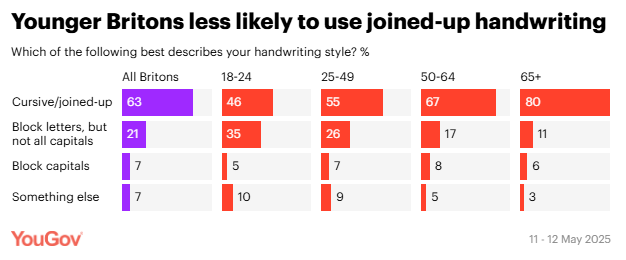
It’s tempting to frame this as an analogue rebellion. Handwriting as the ultimate middle finger to AI. But rebellion suggests opposition. And what is actually happening here is that people are reaching for pens because AI removes friction.
Every time a technology solves a problem at scale, humans invent a counter-ritual to restore the thing that efficiency removed. The printing press made books abundant, so calligraphy became art. Photography captured reality instantly, so painting shifted towards expression. Industrial agriculture fed millions, so organic food emerged as a premium marker. Digital music put every song in your pocket, so vinyl returned as a way to experience sound with intent.
Handwriting fits this pattern. Generative AI speeds up the production of text without effort: writing emails, drafting reports, summarising meetings, generating ideas. This collapses the distance between thought and output. While that’s powerful, it’s also psychologically destabilising. When the gap between thinking and producing disappears, so does the space where meaning gets made.
Handwriting restores that space. It’s slow by design. It leaves mistakes visible. When you write by hand, you’re forced to think before the sentence appears. You can’t scroll back, delete, copy and paste, re-arrange the sentences on paper. You can’t ask the pen to finish your thought.
This isn’t just sentimentality. A 2023 study published in *Frontiers in Psychology* used high-density EEG to measure brain activity and found that handwriting activates far more widespread and interconnected brain networks than typing. The research, conducted by neuroscientists at the Norwegian University of Science and Technology, showed that handwriting produced particularly strong connectivity patterns in theta and alpha frequency bands: brain waves associated with memory formation, sensory processing, and attention. The fine motor movements required to form letters by hand stimulate the brain differently than pressing keys, creating what researchers call “optimal conditions for learning.”
But the neuroscience only explains part of the appeal. What handwriting really offers is proof of presence. In an era where content is infinite and indistinguishable, handwriting communicates effort, intent, vulnerability, time invested. And they’re becoming luxury signals. When everything can be generated instantly, the things that take time increase in value.
You can see this shift happening across culture. Luxury brands are tucking handwritten notes into packaging again. Letterboxd and Goodreads position themselves as “slow social media” where curation and reflection matter more than velocity. Film cameras are back. People post photos of their notebooks, not their Notes apps. Among all the nostalgia, they are attempts to reclaim texture in a world that’s been optimised out of its edges.
Handwriting is being framed as authentic, personal, human. And in many contexts, it is. But it’s also unsearchable, unshareable, and unscalable. For people with disabilities, injuries, language barriers, or neurodivergence, handwriting is a limitation rather than a luxury. The romanticisation of pen and paper risks creating a new hierarchy where physical writing becomes a credential, a proof-of-human gate that excludes anyone who can’t perform it easily.
Throughout history, handwriting style, spelling, even accents determined credibility and access. As AI detection becomes harder and people grow more anxious about what’s real and what’s generated, handwritten notes could be fetishised as trustworthy in ways that disadvantage those who rely on assistive technology or digital tools to communicate. The rebellion risks becoming exclusionary.
Handwriting is often rediscovered by knowledge workers when they are overwhelmed by screens. It becomes the moment you step off the treadmill, just to remind you what it feels like to think without optimisation. And the people writing essays about the virtues of journaling and buying £50 fountain pens are often those that are buffered from Ai taking away their job. Handwriting as resistance only works if you have the time and security to slow down in the first place.
None of this means the resurgence of handwriting isn’t real or meaningful. It just means it’s worth examining what handwriting restores for some people and what it obscures for others. What makes handwriting feel valuable - scarcity, effort, slowness - also makes it inaccessible at scale. The more AI-generated content floods the internet, the more human-made artefacts increase in value. The transparency of the process becomes more valuable than output quality. Handwritten first, AI-refined later. The proof of thinking visible before the final version appears.
Analysis of YouScan social listening data show that the conversation surrounding handwriting is split into a wellness-oriented, digital detox group and a highly technical group focused on the mechanics of handwriting.
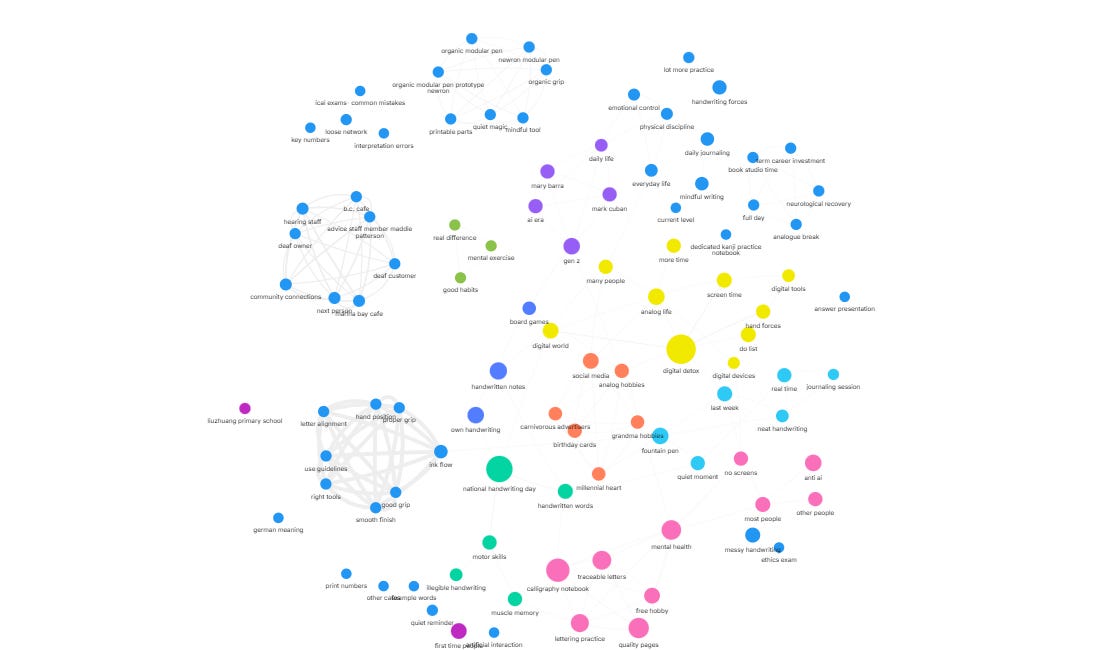
The digital detox side appearing as keywords such as “anti-AI”, “no screens” and “analogue life”, suggesting a conscious effort to escape the influence of what some social media users describe as “carnivorous advertisers.” In this context, handwriting is framed as a peaceful space and an essential mental exercise.
Parallel to this wellness group is a dense cluster of conversation centred on the technical precision handwriting. Terms like “ink flow”, “hand position” and “proper grip” indicate a community of enthusiasts who prioritise the ergonomics of writing. This group is not merely interested in the act of writing but is obsessed with the mechanics of the results: focusing on smooth finish, letter alignment and the use of specific fountain pens.
Demographically, the data also shows a generational shift. While handwriting might once have been associated with older generations as evidenced by the “grandma hobbies” tag, it is being reclaimed with a “Millennial heart”. The engagement of Gen Z and Millennials in events like “National Handwriting Day” suggests that analogue habits are being rebranded as trendy and aspirational. This is further supported by the visual tags which link handwriting to cafe culture, suggesting that the practice has a social, performative element; it is an aesthetic lifestyle choice often shared in public or digital spaces. These generations don’t view handwriting as a redundant skill, but as a multifaceted practice that serves as a tool for cognitive development, a medium for artistic expression, and a sanctuary from digital saturation.
Brands are also jumping on this performance bandwagon. Handwritten fonts are used to demonstrate authenticity, and in the not so far future, AI systems could be trained to mimic imperfection by sneaking in the odd typo. Brands will try to mass produce analogue experiences that is optimised at scale.
When efficiency becomes the only value that matters, we lose the messy, slower process of figuring out what to actually think. There is a connection between the hand and the brain. But it’s not magic, and it’s not universal. It’s just the oldest form of externalising thought we have, and in a world where machines can think faster than we can, that slowness starts to feel like a feature.
Whether that lasts or gets absorbed into the next optimisation cycle remains to be seen. But for now, handwriting is more of a recalibration than a rebellion. A way of reminding yourself that you were here, you chose these words, and that mattered, even if no algorithm will ever notice.